

86: מנהיגות מוכוונת אימפקט - חלק 1 (English)Episode 66ערן זינמן
ערן זינמן
86: מנהיגות מוכוונת אימפקט - חלק 1 (English)
אנחנו מדברים על הובלה באמצעות אימפקט ואיך היא יכולה לעזור לנו להתקדם מהר יותר, ועל השגת שלמות באמצעות איטרציה. אורח: ערן זינמן, מנכ״ל ומייסד-שותף במאנדיי.קום
You know when you start working on a project that seems pretty small, only to end up working on it for days - sometimes even months - more than expected?
Those of you who have listened to our podcast before know that we are an impact-driven company. In practice, this means we believe in achieving perfection through iteration. Investing our time in learning by executing quickly, analyzing the results, and executing again. Rather than by months on months of research.
In this week’s episode, Lior Krengel and Eran Zinman talk about impact-driven leadership and how it can help us move faster.
They discuss the reasons for analysis paralysis, how we can overcome it, and why going against our intuition can actually help us in these cases.
“Companies are moving so fast today and everything is so dynamic, and I think the ones that fail are the ones who stop innovating and making changes, and eventually slow down and die. The ability to move quickly is relevant whether you’re a small team or a big company, in order to stay in the game and be successful.” (Eran Zinman)
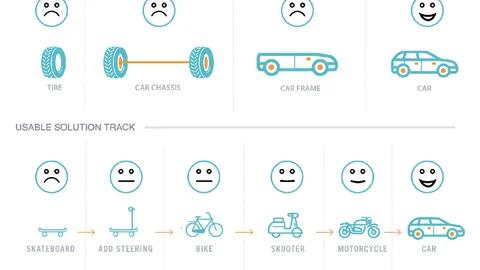
The MVP diagram. By Aaron Lawrence on Medium
Episode transcript
Automatically transcribed — it may contain errors.
Hi everyone, you're with Startup for Startup, the podcast on which we at Monday.com openly share knowledge, experience, and actionable insights among startups. Startup for Startup for Startup. My name is Lior Krengel, and together with me is Eran Zinman, co-founder at Monday.com. And we're here today to talk about impact-driven leadership. Yeah. Yeah. Big word. Impact-driven leadership. Yeah. We hope to make it more down to earth in the next hour. Yeah. Sounds very vague, but this is the best title that we found. Right. Yeah. But hopefully… But it's bottom-up title. It's like, first we had the content, and then we came up with the title. Yeah, yeah. So hopefully it's real. So in a few words, what is this episode about? There's two ways for me to frame it. I would say what I think makes companies successful, kind of what's the ingredient that makes companies successful and unsuccessful. And on the other hand, I will say, from my experience, what I saw that slows people down or make them not succeed with what they need to do, and so on. Who is this episode for? Yeah. So I use the word leadership, because it's also kind of self-leadership, if you like. I call it leadership because it's about taking control of the process, whether you're managing people or just dealing with it yourself. It's about kind of understanding what you need to do and taking control of it. So I like the word leadership here. But I think it's for everybody. Everybody in our company, everybody that's listening to this episode, whether you manage people or not. Yeah, I think it's for anyone who's trying to own the experience they have at work. You want to own the experience. You don't want the experience to lead you. So there are a few ideas that are the basics of what we're going to talk about now, right? So the first idea is that execution leads to success. Yeah, so it's important because this is something that I feel deeply about, is that there's many reasons why a company or a team is successful. I think one of the most important ones is execution. Specifically, I would say speed of execution, your ability to execute quickly. And I feel that we as a company, it's one of our biggest strengths, the ability to execute quickly. And the way I feel it is that whenever we have a problem, whether it's something caused by an external problem, whether it's a gap that we have, anything, we can overcome. And I try to understand why I feel this feeling of confidence. It's very deep. I still don't sleep in a lot of nights, but I still feel very confident because I feel there's nothing that can stop us. Because even if we identify anything, any gap or any issue, we can fix it because we have the ability to do so. And not only that we have the ability, but we can also do it very quickly. So this gives me a lot of confidence in our ability to move forward. And I think that today in age, it's even more important than ever because companies are moving and changing so fast. Everything is so dynamic that I feel the ones that fail are the ones that eventually slow down and just stop changing things, stop innovating, stop making the required changes in order to move forward and eventually slow down and die. So I think the ability to move quickly is relevant, whether you're a small team or a big company, in order to kind of keep in the game and be successful. I think also that the COVID-19 thing just made it more clear to everyone. Even if I think about small businesses such as restaurants around us, you see so easily the difference between those that are just in a shock mode. Something happened. Now they're freezing. They don't know what to do. They're waiting for it to go away. And they close their doors until it goes away. And those just adapt quickly. If it's delivery, if they just change the concept or business model so that they can continue living in those new times. And I think you can see that today more than ever. Yeah. I think something that COVID-19 triggered was an acceleration of processes that already existed. And across every industry, I think the ones that kind of benefited from that were the ones
that adapted quickly and made all the relevant changes in order to survive and even flourish in the current situation. You know, often when I say this, people kind of take it as it is and say, oh, so you're basically saying we need to move faster, but what about strategy? Does it mean that we just need to do stuff quickly and that's it? But I think that we need to have the combination of both. We need to have a very clear strategy of where we want to go, but also have fast execution because I've seen companies that have only very fast execution, no strategy, big failure. It's like a bunch of headless chicken running around. I've seen companies with an amazing strategy, so many discussions and debates without the ability to execute. And a great presentation. Yeah, everything looks so sharpened, but a year passed by and nothing has happened, so literally no execution. Or actually everything that was on the plan happened and that's also a problem. Yeah, because… If you just execute on a plan. Yeah, that's right, because things change so much during a year, it's unbelievable. And I think having the combination of both is the key to success, one of the important keys to success. Okay, so let's assume we have strategy. I'm not going to talk about strategy too much because this is not a topic, but assuming we can understand where we are, point A, and we want to get to point B, what is the most efficient way together? So this is kind of the framing of this discussion. And I think we should add already at this point that it's how can we get somewhere quickly, but make sure that we have air and that everyone's happy around. Because you can always say, oh, let's just get somewhere quickly by working 24-7, you know, making our lives miserable. So this isn't the point. The question is when you say efficient, it's not like machines or something, it's like for people how to get somewhere quickly, right? Yeah, the word is efficiency. The last thing that I want is for people to work harder. This is not the point. I think, you know, the other way around. If we're super efficient, we can work less and be more focused on what we need to do. So definitely that's not the message. Do you want to present the idea of achieving perfection through iteration here? Yeah, so I think this is kind of the key sentence that which we're going to discuss, and I frame it as achieving perfection through iteration. What does it mean? Right, so basically you want to get from point A to point B. Now everybody want to do it in the best way possible. So this is kind of the perfection part. And I think everyone can agree on that. You know, we live in a society that is very competitive. Everyone is very much high standard driven. And so perfection is… You want to do a good job. Yeah, exactly. The best job you can. Through iteration means that what's the method to get there? And the key message here is that we need to iterate, get feedback, and change constantly in order to do so. Which is kind of counterintuitive. Yeah. Right? Yeah, that's kind of the main issue. Like, you know, I gave this presentation already three times and always have a discussion with people. And I can also tell by myself that people intuition always goes to the best way to achieve perfection is to carefully plan what we're going to do, think about every angle, every aspect of what we need to do. Talk a lot. Talk a lot. Consult with other people. Get feedback from people, not user, but, you know, colleagues or whatever. And then carefully execute that, have a, you know, Gantt chart, whatever, and then deliver something after six or eight months. Hoping it's perfect. Yeah. Yeah, because you want it to be perfect. Right. That's people intuition. And we're going to talk about the opposite of that, basically. So it's kind of a different way about thinking how to do it, in a way. So this is kind of the very fundamental thing that Roy and I built the company based on. Everybody, each one of us had his own experience. I can share from my story that I have like bottle scars of what made me think in a very different way because in my previous startup, I've done the opposite. So I wanted to create something that's perfect. I worked very hard to do that. You know, working nine, ten months, just creating a product, didn't get any feedback, didn't get any validation about my idea. My head was literally spinning
Thinking about all the angle they didn't do, all the nuances, details, you know, I went into this analysis paralysis mode. And then not from a position of strength, but from a position of I had enough, I launched it, only to find out that nobody wanted to use that product, you know. And I could have achieved this understanding nine months before that. I could work for one month and get the same, to be in the same position with much more energy. I just fell in love with what I built and nobody cared. So it was like the worst experience in my life. And I can talk for my partner, he kind of had a similar experience. So we took a very different approach on how we built Monday and how we run the company. Let's just give an example of what it means when it doesn't work, right? Let's just start with how it looks like when it's not leadership that is leading to impact. I have like a million of examples. I think this is something that happens every day here in the company. It's not unique to any department or any person. Also myself, by the way. Like I always try to improve how I do things. I think there's one example that really stands out that I've mentioned in the session that I gave to the R&D team. And they allowed me to use the same example here. So I'll just share it. So the team here in the company worked on a new feature 14 months ago. So 2019. Started working on a feature. Yeah. Well, they started working on it and finished working on it in a few days. It was a feature highly requested by our customers. We wanted this feature. So the feature was, you know, without getting into too much details about the product, adding ability for people to freeze. So currently when you scroll horizontally on our board, the first column is frozen, meaning that you can still see it when you scroll. So a lot of people ask to freeze additional columns. So like the first two, the first three columns. And they added this feature. It's not very complex, right? So the story is they built it 14 months ago, but only released it two weeks ago, even though it took them a week to work on the feature. Wait. Yeah. 14 months ago, a team here at Monday worked on a feature. Highly requested. It was ready after a few days, a few weeks. Yeah. And it was released only two weeks ago. Yeah. The fact, the surprising fact is that they didn't change anything. So it's the same code, same implementation. So what happened? So what happened was… Because let's establish already one assumption here. We think always when we talk about leadership, right? I know you agree, so I'm talking for the two of us, that people have the best intentions and they want the best for the product and for themselves. So it's not like they work, oh, let's take the time. That's not the case. So what really happened? Listen, in terms of quality of people, it's one of our best teams in the company. So what is it? What happened was they created a feature. They actually opened it for our account. So because we're using Monday ourselves. But anyway, they had a few gaps. They didn't know how to close. So one of them was some assumptions that the feature is not good enough because of XYZ. And XYZ wasn't a technical thing. It was how people are going to use it when they're switching between views. Should we keep it constant? Should the same person see the frozen column as the rest of the people? Usability stuff. Yeah, a lot of questions about this feature, you know, unknowns. So they started debating and then it got postponed. And then something urgent happened and they had to move to another project. And then they got back to it, but it was kind of low priority, so they didn't do anything. And then it became like a complex thing because three, four months passed. So people try to think, or you think it's complex because we didn't do it. We need to solve a bunch of stuff. And then you invent the dependency. So you're saying, oh, we're going to redesign the header, the user interface of the system. So let's wait for that. And then this project got delayed. And then you get to a very ridiculous state where you say, just so much time passed, I'm not going to release it. You kind of feel familiar with this feeling? Like it's been too long?
You feel that if you're going to release it now, it's a way for you to admit you… You must prove it's amazing because it took you so long. Exactly. Right. Yeah. And also the other way around. If it took me so long, there must be a reason. So I'm going to sometimes invent problems. Now I'm talking about myself, right? If something is taking me so long, there must be a reason that is not just my ego and my fear and my life. So let's just say that website building is hard. Just imagine around, take in my own cases. Yeah. So this is a story and there's a lot of nuances and kind of my view on why it happened, but it's not unique. And we tell it here just to give a, you know, just to make the point on how it looks like when it doesn't work. Yeah. Okay. So we mentioned perfection through iteration. And as you said, this is like the fundamental idea of our episode today. So what does it really mean? How does it look like in reality and work? Yeah. So, you know, I think all of us heard about the concept of MVP, building an MVP. So MVP stands for minimum viable product. And that means a product that works, but it's not kind of the ultimate version, right? It's not the final version. The point is that the way you should kind of approach everything that we do in the company is build, measure, and learn. This is kind of the process. So you build something very basic, I would say. It works, but it's not like the ultimate version. You measure, so you see how people kind of, you know, react to the product, what kind of feedback that you get. And then you learn out of that and then build again. So basically, it's an ongoing process. A never-ending one. Yeah, a never-ending one. But the difference between that and just building something very complex is that you get real feedback from real users in the real world. And once you get that, you're in a totally different position from where you were when you started the project. And the point is to have as many iterations as possible and as quick as possible between iterations. And, you know, I mentioned the example about my startup, but, you know, I could be in the same spot exactly one month after I started instead of 10. So this is one example. So the concept is getting constant feedback, changing, improving, and then building and going through the process again. It's like a circle. And it's also relevant not just to building products. It's relevant to marketing, to sales, to let's say you have a new message to pitch. So you can sharpen it and sharpen it and talk to many people or you can just go with a basic idea, talk to a few customers, get their feedback, and then go back to the room and work on it again. Or you can make a video for, you know, for a YouTube ad. And you can work on it for three months or you can have something, go with it. If it doesn't work, you take it off. If it works to some extent, you make it better for the next version. Yeah, but any team. So if you are a sales team and you have an idea to create a new pitch deck, so just, you know, do it in a week, you know, show it to customers, get feedback, and improve it. If you're in a customer success team and you have an idea to build a knowledge base, so just go for a week, build a knowledge base, see how people act with it, what their feedback is, and then improve on that. The concept is that once you release it in production and people kind of give you feedback, you're in a much different situation than where you were when you started. Right. And it's so easy to stop and not work like that. I'll give an example. We just started in Hebrew so far a new series of episodes. We called it Fundamentals. And then we decided to change it into Foundations. And we weren't sure about name. And it's so easy to sit in a room and say, okay, we won't release it until we decide on a name and it has to be the right name. Yeah. Or you just release it with a name and if it doesn't work, you change it. Who cares? Yeah. And I can give so many examples for that. It's so easy to stop and say, oh, until we figure something, as you say, to create like dependencies that are not really out there, but to think that they are there and you can't move before you solve them. Yeah. So this is kind of the concept. There's one cool illustration that I really like to kind of explain this way of thinking about building products is how to build a car. So it's a cartoonish illustration, but I think it really explains it. So, you know, if you go back to before there were, you know, cars or any kind of vehicles and you would think how are we going to build a car.
They didn't know there's a thing such as a car, right? It's very hard to imagine a car where you have nothing that's kind of motorized. But you're going to say, oh, I'm going to start with a wheel, two wheels, then I'm going to build the body of the car. I'm going to add a roof to the car. I'm going to, you know… A wheel. Yeah, a wheel that I can drive with, a gear. But it doesn't work like this in real life because nobody could think about a car before you had a skateboard. And nobody could think about bicycle before you had a skateboard. And nobody think about a motorbike before you had a bicycle. And nobody could think about a car before you have a motorbike. So the point is that through every iteration, your perspective changes completely. And people often think that they know now what they know now and they have all the details and all the information in order to make the best decisions for the future. But this is false. This is kind of our ability to think that we can control the future and very good with predicting what people would want. This is kind of more of a place of humility where you say, I can only see the next step. I have a vision, right? I know what point B is, but I can only see the next step. I'll build the next step. And then I'll see what's the next step afterwards. And I'll be in a much different position than where I am now. By the way, there's a great book, I think by Daniel Goldberg or Goldman, I'll check, on happiness. And his argument there is that even for ourselves, our current present me doesn't know what my future me wants. And at many times, if a conversation would have gone through the future you and the person that you are today, it would have been like, are you stupid? Why did you think that I'd want you to save money for traveling all over? Of course, I don't want to do that. We just don't know what's going to happen in the future and many things that we do even for ourselves today. So let alone for users, for people that we don't even know. It's so, so deep in such a deep bias in how people think. Definitely. Okay, so you explain how we build things. Yeah. So specifically, I want to talk about speed because we're talking about the method, but basically the method is to be faster. And it happens to me a lot where I approach a team and say, listen, I think you're doing a great job, but you need to move faster. And because I know, because I know how fast teams can move, because I know that speed is important to our success. And then there's a lot of misconceptions when people hear this. So when I say you need to move faster, people think, oh, so we need more people. We need more people in order to move faster. This is false a lot of times. More people means more updates, more overhead about every decision, more opinions. So I don't think so. This is not what I'm trying to explain here today. So the framework that I'm using is how you can become a thousand percent more effective with the people you currently have, with your current team. So people usually when I say this, it's like they look at me in a weird face, like we can, like with the same people, we work in very hard, we're doing what we're doing, so we can be a thousand percent more effective. Yeah, and we want to sleep at night, so no way. And I tell them, I don't want you to work more hours. This is not my intent. From what I analyzed about myself and every team that I've met, that we had this discussion, is, again, I'm not a psychologist, but I feel one of the key drivers of what postponing people and not allowing them to move forward is fear. This is from what I've seen. Always goes back to fear. People are afraid. And I was afraid as well. I'm not different. Like when I started my startup, the previous one, I was afraid. Now in retrospect, I know I was afraid. I was afraid to make mistakes. I was afraid what people are going to say about me, about the product that I have built. I wasn't proud of it enough. I was afraid of criticism or what the users will say about my product. And I feel almost all of our teams are kind of in the same position. So they need confidence. Like how do I know that what I've built or the decisions that I've made are the right ones? I feel insecure about this. I just want to emphasize here that the reason you think, because I'm thinking myself here, okay, but why speed? Why speed?
The reason you talk about speed is because, as you've mentioned before, the only way to learn is by making actions. The fastest way to learn. Right. And to achieve perfection. The best way to learn is by doing things. Yeah. So just go and do them. Yeah. As fast as you can. Yeah. And learn. The point is you need to learn as fast as you can. So the assumption is you don't know what you don't know. You want to achieve perfection. So this is the best way to do it. That's it. And it's counterintuitive, again, because people… Because our mind will think, oh, wait, I need more information. I need something else to happen. And you're saying, no, what you have now is enough to do the first move. And you'll learn from that. And this is how you'll move on. And this is how you're going to achieve perfection eventually. Right. Yeah. People think they know what our users want, how the end result will look like. They think they completely understand all the steps they need to get from point A to point B. And they plan all the steps ahead to avoid mistakes. But what happens usually is what we call analysis paralysis mode. So you start thinking about every tiny detail. You mentioned the name of the podcast. So I've seen so many founders debating for hours over hours about the names of their startup because you start thinking about strategy and then you become confident. So you start thinking about what kind of code you want to write. And then you start thinking about the design. And then you eventually think about the name. And you finish the day exhausted. You didn't move an inch. Right? Like in the same position. But you thought so much. Yeah. You surrounded yourself with so much information. And guess what? Tomorrow is going to be worse because you have all these details. You're going to continue the discussion. You're going to get into a paralysis mode. And I experienced myself. You know, it's just paralyzing. And, you know, maybe somebody that listens to this episode will do like a frame for that. It's not for every company. You know, I think it applies to almost any tech company and a lot of other companies. But it obviously can't work if you're building airplanes or you're in construction and building a high riser. When you do that, you need to understand all the – because you don't want the plane to crash or the building to fall apart. So you need to kind of plan every single move that you do. And it's very hard to do so. But in any environment which is dynamic, which is easy to change, this is the best way to achieve perfection. This is kind of the framing because some people might listen to this and say it doesn't apply to every industry. And they're right. But I think any – Or I would say I think it applies to every industry but not to every process in every industry, you know. I can even think about how some people are trying to find a founder, a co-founder, you know, and they're like for one year just looking for a co-founder. Because they have this checklist in their minds and they can't find this person because it doesn't exist. And it doesn't even – they don't even know that this is the right person for them. They just have a checklist, you know, those kind of situations. And then just trying or just working or just starting something with someone could have got them much, much further on what they need. It's funny because when I thought about examples, the airplane and building a high riser, another thing that came to mind was building a spaceship. And then I thought about Elon Musk, which took an industry that was, you know, very slow moving and he managed to do very fast iteration and to build a huge company with many experiments. So I guess it's also a very mental kind of game. Eran, until now we gave only examples that are very, very tactic, I would say, or very, you know, specific to teams and myself. Do you have an example of something more high-level, company high-level strategic to where you had to make a change because you saw that you were just slowing down, thinking too much, not doing enough? Yeah. There's one, like, very big event that I remember. Everybody that was here in our team remember that. I love when you say team when you're 600 people. Team! So team. So it's funny because I look at all of our board presentations since 2017. And you have them quarterly, right? Yeah, we have every quarter a board meeting. And a big part of what we go through in a board meeting is product updates. So everything that we've done in a quarter, all the progress that we made in our product. And what I've done is to go through this section and just list all the big things that we've done. You mean big features we release, big product advancements. Big product advancements, yeah.
And then, because I remembered, you know, one occasion. So, you know, starting from 2017, I wrote it down, but every quarter there were like, I would say two big features that we launched. And then one board meeting that I really remember is the one in February 2019. And I remember that one, not for a good reason, because we were working on the board presentation and we got to the product section and we started kind of thinking, okay, so let's think about what we've done in the past quarter that's significant. And we couldn't find anything. You know, it's weird. And the weird part was that the team was working really, really hard. And then I look at that presentation and I saw that one of the features that we highlighted for the board was the fact that we added more colors to our status column. That's one of the big three. So I remember the face, maybe it was just my feeling, but I remember the face of our board members when we said it. And they were like, okay, that sounds good. We had a status column, let's just explain. And it's used to have maybe green, red, and now we have also pink, purple. Yeah. And that was a major feature announcement. Well, that's the best we could find. For that quarter. Yeah. Although the team on a weekly basis, you heard them work hard. Oh, I saw them working super hard. So it's not about motivation, best quality of people I ever worked with in terms of engineering, product design. It's not about that. I knew that because I know everybody individually. So I remember that like a week after we had like a urgent meeting, like the leadership team in Monday. Right. And it was a harsh one because we sat down and we try to figure out why is that? How come? And we kind of dug deep and we understood that it was 100% mental. We couldn't move. Every time we wanted to change something or add a new feature, we had a meeting after meeting after meeting. Everybody had a million opinions. You just felt stuck. You felt like everything needed a committee. Why? Why we got to this situation? What's the hidden thought that makes you go into one meeting and another meeting instead of doing something? I think that's the, this is where people energy go by default. I think you need to spend time and energy and effort in order to make sure you're not going there. But no, but I mean more specifically, did something happen during that time that was like, were you afraid of breaking the product because it was working so well? It's a gradual slowdown. By nature, you mean? Yeah. So we sat down. We sat down and we said no more. Like we're going to become super unsuccessful as a company if we don't move forward. There's so many gaps. There's so many features that we're missing. And we took a very different approach. We said what's impossible? You know, it's funny to have this discussion. Like what's what we wanted to do but it's impossible to do it. And we try to frame it in two weeks, you know, just for the sake of it. What's what we can do that we want to do but it's impossible to do in two weeks. And then we listed all those things that we feel was a major gap in our product. And then we said, okay, let's take the first one and do it in two weeks. Just force ourselves to do it in two weeks. Whatever the result is, we're committed to releasing the production and just give it to our users. And that's it. We all agreed on it. We all bought into it. Everybody was in the game. And we harnessed the whole company towards that. So we communicated the same message. We communicated that we don't make enough progress. It's not about how much people work or the effort or the quality of people. It's about… Achievement. Yeah, it's kind of about what happened to us. And everybody was part of the problem. I was part of the problem. The leadership in the company was part of the problem. And we just told them, let's do it in two weeks. And we didn't say it in a kind of bossy kind of way. Oh, you have to do it in two weeks. This is the deadline. We said, listen, this is what we want to do. We need your help. Let's try to make it happen. We trust you. You can do it. And in two weeks, we released one of the most amazing features that…
we've done, which is a column center. So we added about 16 or 17 columns to the board that had only six in a matter of two weeks. Now, just to give you the context, so for a very long time, we wanted to expand six columns to seven columns. And we had an idea about a new column that we want to add to the board. And it didn't happen for four or five months. And then in two weeks, we released 16 of them. Yeah. Not one, 16. Yeah. It was amazing. And it was easier to release 16 in two weeks than to release one in four or five months. Yeah. It was amazing. And then the team got addicted. So what's next? But it really changes the focal point, you know? That's what happened, really. What? Because if you're trying to decide on one, it's so dramatic. Just trying to put myself in your shoes. So dramatic. How do you decide what's the seventh? You know, you have six and then a seventh. Now if you had 16… I would agree, unless all the other examples are different. Because then we said, okay, so we got columns. So what's our next, you know, big dream? So next big dream is to add views. We want to add views. So different ways to visualize the data in our board. We didn't have any single view. We didn't have this feature at all. So we said, okay, let's add views in three weeks. Can we do it? See, but you're only strengthening my idea here because you're saying views. It's not one view. I think, really, I think an outer mental thing. Maybe. Many times if you think it's day one, you know, it's also like freezing and then paralyzing. And if you think, oh, views. So we can have a few. We can kill some if they're not good. Let's surface the best one. One thing that I've noticed, there's so many things I've noticed when the team was working. To make a long story short, the next board meeting in July 2018, we announced, well, not announced, but kind of presented to the board the fact that we added a column center with 16 new columns. We added board views with five new views. We added a feature called My Week. We added an activity log. We added an integration with Slack. The amount of progress that we've done in three months was more than what we've done the whole year before that. Same people. Same people. Different energy. Not about energy. They were 100% energized. Just different mindset. Different mindset. And, you know, when I kind of inspected their behavior and how they acted during that time, first of all, I would say they were super happy because I feel what frustrates people is the fact you don't move forward. When you feel you move forward and every day is different and you make progress, this is what makes people happy. And I remember when we wanted to schedule a meeting or, you know, tell them something or give them feedback, their reaction was, sorry, we don't have time. We're focused. Whenever they had a, you know, a junction, they had to pivot between A and B. They just decided because they don't have time. They just want to do it. And we released all those features and they weren't perfect. Like, you can't create the perfect thing, but we got feedback, we improved, we got feedback, we improved, and then it became perfect in the shortest time possible. So we kind of kept that and the next board meeting afterwards. So it's been like that for, I would say, ever since. But it really changed how we think about things. And, you know, going back to the example I gave in the beginning of the episode about the team that it took them 14 months to release the feature of freezing a column. So we had this discussion before they released it a few weeks ago when I gave the presentation. So I asked them kind of a mental game. I asked them what would have happened if 14 months ago you would release that feature on the same day that you finished it? What do you imagine this feature would look like today as opposed to… What it actually looks like today. Yeah. When you were super afraid of how people would react. And it was obvious to everybody it was much better, much improved with feedback. Actual usage or customer would be much more happier right now because they have this feature. Well, some of them that want it. And that's the story, basically. Like the fact that you move forward, you get feedback and improve on top of it without being afraid of the consequences. So I think this would be part one. And on the next part, part two of our impact-driven leadership episode, we'll talk about techniques and strategies to overcome that, right? Because I think we established on this first
how deeply we are rooted to work in the way we just presented, but we do have some ideas to share on how to overcome that. Yeah, I think kind of what we can do in the next episode is talk about how to kind of practice it, first of all from a personal perspective, but also as a leader, whether you manage a team or yourself, how to deal with your team, how to harness everybody to doing that, how to motivate people to do that. Right, and we have some concrete techniques to do that, yeah. Yeah, the pitfalls, so that's kind of the… The next part. Yeah. Thank you, Ran. Thanks, Leo. Thanks for listening. Startup for Startup. Startup for Startup. Startup for Startup. Startup for Startup. Startup for Startup. Startup for Startup. Startup for Startup. Startup for Startup. Startup for Startup. Startup for Startup. Startup for Startup. Startup for Startup. Startup for Startup. Startup for Startup. Startup for Startup. Startup for Startup. Startup for Startup. Startup for Startup. Startup for Startup. Startup for Startup. Startup for Startup. Startup for Startup. Startup for Startup. Startup for Startup. Startup for Startup. Startup for Startup. Startup for Startup. Startup for Startup. Startup for Startup. Startup for Startup. Startup for Startup. Startup for Startup. Startup for Startup. Startup for Startup. Startup for Startup. Startup for Startup. Startup for Startup. Startup for Startup. Startup for Startup. Startup for Startup. Startup for Startup. Startup for Startup. Startup for Startup. Startup for Startup. Startup for Startup. Startup for Startup. Startup for Startup. Startup for Startup. Startup for Startup. Startup for Startup. Startup for Startup. Startup for Startup. Startup for Startup. Startup for Startup. Startup for Startup. Startup for Startup. Startup for Startup. Startup for Startup. Startup for Startup. Startup for Startup. Startup for Startup. Startup for Startup. Startup for Startup. Startup for Startup. Startup for Startup. Startup for Startup. Startup for Startup. Startup for Startup. Startup for Startup. Startup for Startup. Startup for Startup. Startup for Startup.